
What's Included

Chapter 1 - Introduction

I’m hoping to simplify the process for you by presenting the fundamental principles behind good painting.

Chapter 2 - Equipment + Supplies

Getting prepared to paint in pastels doesn’t have to be a daunting task. Take it one step at a time.

Chapter 3 - Warming Up

Before we start with our first piece that is a simple but powerful warm up, we are going to spend a bit of time getting to know these sticks.

Chapter 4 - How to Simplify

We need to simplify! See it simply and paint it simply. Easier said than done.

Chapter 5 - Value Does the Work

The success of any painting depends on value more than any other aspect.

Chapter 6 - Color

As painters we need some kind of reliable way to talk about and work with color.

Chapter 7 - What to Paint?

To paint a thing, I have to see it with innocent eyes; eyes like a baby.

Chapter 8 - How to Use Photographs

I use photo reference all the time, so of course I believe that it’s possible to use photos effectively to make good paintings.

Chapter 9 - Self Critique

I’m hoping to simplify the process for you by presenting the fundamental principles behind good painting.
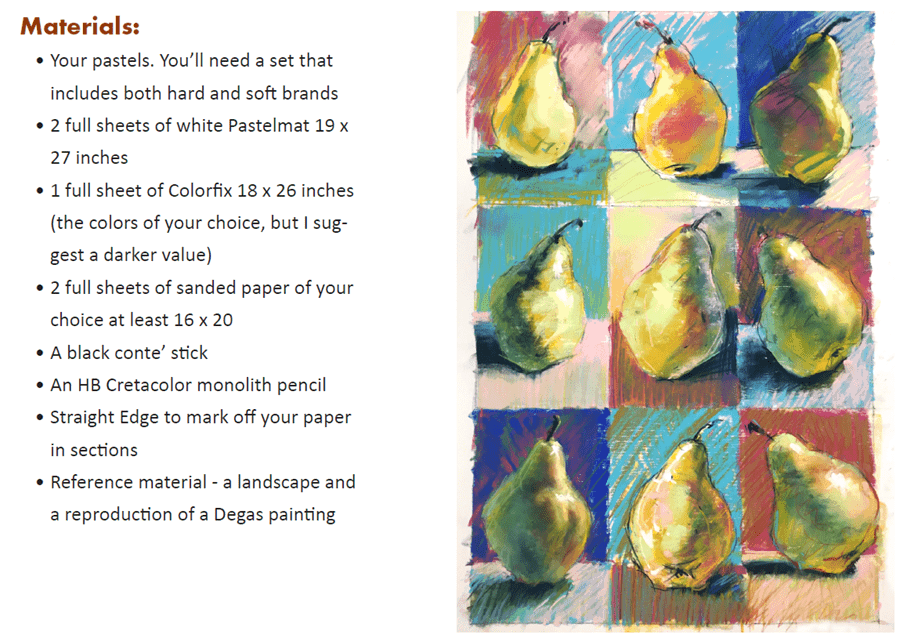
I’m pleased to bring you this in-depth workshop, “Making Your Mark”! I created this workshop to help you further develop an individual voice or style as a painter which I think is something every student I’ve worked with wants to achieve.

Pianists often spend years and years developing a “touch”. This is different from the grammar or structure of a piece of music. It’s what makes us hear the difference between musicians playing the same piece. Miles Davis said “it takes a long time to play like yourself. “

If you’ve worked with me a bit, know that I’m a firm believer in mileage over talent. We need to put in our time and grade and we need to do it intentionally. Here’s where this workshop comes in.

I’m still fascinated by pastels and their ability to convene not just color, shape or things like depth, but emotion and mood. We can make a virtually an infinite variety of marks with these simple tools by altering the pressure, velocity and direction of our hand. But we want to have some control over this. To gain that control, we need to explore as many possibilities as we can.

We also need to distinguish between what might be our preferences (which are great and help us to hone our style) and our biases which could be holding us back or keeping us in a rut.

We are going to start by examining the four principle modes of mark making then we are going to put in quite a bit of mileage in combining them. Finally, we are going to revisit the idea of copying work that we admire.

-Marla

Scroll to Top